

Your employer brand isn’t something companies build from scratch. Aware of it or not, it already exists.
Right now, candidates are Googling you, reading your Glassdoor and Indeed employee reviews, scrolling your LinkedIn and social media pages, and asking people they know if your company is a good place to work. And whatever they’re finding (or not finding) is shaping whether they apply, whether they accept your offer, and whether they tell their network to do the same.
So the real question is: are you in control of that narrative?
According to Built In’s 2026 State of Employer Reputation and Visibility Report, only 24% of companies say their internal and external brand perceptions are actually aligned. Meaning three out of four companies think they’re coming across one way to candidates, and they’re not. And only 44% are very confident in their employer reputation at all.
That’s a significant gap — and for growing companies competing for the same talent as bigger, better-known names, it’s a gap that costs real money. It’s also one that more companies are waking up to: Built In’s 2025 Talent Trend Report found that 51% of talent leaders are actively expanding their employer brand investment.
The message we should takeaway? Companies taking their employer brand seriously are pulling ahead. And the ones treating it as an afterthought are really feeling it in their pipeline.
Candidates Are Already Researching You Before You Even Know They Exist
Most leaders think of hiring as something that starts when a candidate applies. In reality, the decision to apply (or not) has usually already been made long before anyone fills out an application.
75% of candidates research a company’s reputation before applying — and they’re doing it before they even look at salary or job title. 86% of job seekers look at a company’s reviews and ratings before considering an application. And 62% look up a company specifically on social media as part of that pre-apply research.
So what this all tells us is that by the time someone shows up in your applicant pipeline, they’ve already formed an opinion about you. If what they found was a sparse LinkedIn or Facebook page, a couple of old Glassdoor reviews with no responses, and a careers page that hasn’t been updated since 2022, they’ve already started second-guessing whether to apply at all. And the ones who didn’t apply? You’ll never know they even considered you.
Even when unemployed, 81% of candidates say they wouldn’t join a company with a bad reputation. And 72% of candidates who’ve had a bad experience share it — online or directly with their network. So bad experiences spread faster than positive ones. In reality, a poor candidate experience doesn’t just cost you that one hire. It costs you everyone in their orbit, too.
What Candidates Actually Trust (And It’s Not Your Careers Page)
Here’s a common disconnect we come across time and time again. Companies invest time and money polishing their employer brand messaging — rewriting their careers page, updating their “About Us,” crafting a mission statement — and then wonder why it’s not moving the needle.
The careers page is just one piece of the puzzle. And if the other pieces don’t fit, you won’t be giving candidates a confident enough picture to make them want to work for you.
Only 17% of candidates believe employers are very honest in how they present their brand. And candidates trust a company’s employees 3x more than the company itself to give credible information about what it’s actually like to work there (and our bet is that number is even higher). Personal reviews carry more weight than anything a company can say about itself. Just look at how people rely on Yelp and Google Reviews before trying a new restaurant. Employer reputation works the same way.
So the most powerful employer branding tool you have isn’t your careers page. It’s what your current employees are saying on LinkedIn, in online reviews like Glassdoor, and in conversations with their networks. That’s what candidates are searching for and believing.
Built In’s 2026 report backs this up. Culture and values (47%), leadership credibility (43%), and company mission (39%) are the top reputation attributes candidates actually care about. None of those come through realistically on a polished careers page. They come through what real people say about you.
That’s not to say your careers page doesn’t matter — it absolutely does. But if what’s on your page doesn’t match what your employees are saying publicly, candidates will pick up on that mismatch quickly and move on.
AI Is a New Puzzle Piece (And Most Companies Aren’t Ready for It)
Remember how I mentioned that employer branding is like putting together pieces of a puzzle to create a bigger picture or impression? Well, AI is the new huge puzzle piece you need to be aware of.
Built In’s 2026 report found that 91% of talent acquisition and HR leaders say AI tools now influence how candidates discover and research employers. But only 33% are confident their employer brand is accurately represented in AI search tools. And 73% are concerned that candidates are receiving outdated or inaccurate information about their company through AI search.
Think about the risk factors here if not corrected. A candidate asks ChatGPT or Google’s AI overview “what’s it like to work at [your company]?” and the answer they get is pulled from whatever’s publicly available, like old reviews, an outdated press release, and a Glassdoor comment from a disgruntled former employee. If you haven’t been actively building and managing your employer brand presence, AI tools are filling in the gaps for you, and not necessarily in the way you’d want.
The Built In report also found that AI search values content that comes from third-party authority, direct employee insight, and topical depth — not your careers page or company blog. Which means the employer brand work that actually moves the needle in an AI-driven world has to happen out in the open, through your people and through credible outside sources.
AI is genuinely new territory for us all, and most companies, even well-resourced ones, are behind on it. Only 35% of talent leaders feel prepared to optimize their content for AI search.
The Real Cost of Letting Your Brand Run on Autopilot
Companies that haven’t invested in employer branding tend to think of it as a “nice to have.” Something to get to eventually. But the cost of not managing it isn’t neutral — it shows up in your recruiting budget, your time to hire, and your turnover numbers whether you’re tracking it or not.
Companies with a strong employer brand see a 50% reduction in cost per hire. Flip that around: companies without one are paying significantly more for every single hire, whether through higher recruiting fees, longer time to fill, or compensation premiums to overcome a reputation they haven’t actively shaped.
26% of job seekers declined an offer in 2026 due to a poor hiring experience. Not a bad salary or a bad role, but because of a poor experience during the interview process itself. And that process — how you communicate, how organized your interviews are, how long it takes, whether candidates feel respected — is an extension of your employer brand whether you’ve designed it that way or not.
And then there’s the huge upswing side of it too. Companies with strong employer brands attract 50% more qualified applicants. Not more applicants in general, but more qualified ones. That’s significant! It changes the entire equation, where now your team also spends less time sorting through the wrong people and more time actually evaluating strong candidates. Not to mention how much stronger of a workforce you’ll have with a better candidate pull to choose from.
I think we’ve made our case clear at this point, but one more compelling fact to share. Built In’s 2025 report found employer branding ranked as the third most effective recruitment channel overall, just behind referrals and third-party job platforms. And driving retention through employer branding was ranked the number one employer branding priority for HR professionals. So it’s not just about attracting people — it’s about keeping them, too!
Step 1: Perform an (Honest) Audit of Where You Are Today
Before you can improve it, it helps to understand what candidates are currently seeing. Here’s a quick audit worth doing:
- Google your company name. What comes up? Is there a knowledge panel? Any news? Reviews? What’s the overall sentiment of the first page of results? What does Google’s AI overview summarize about you as a company?
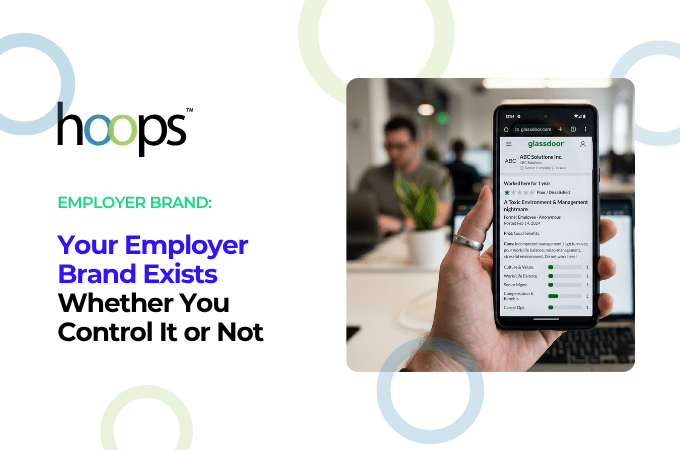
- Check your Glassdoor and Indeed review pages. How many employee and candidate reviews do you have? What’s the rating? Are there reviews that haven’t been responded to? Candidates notice both the reviews themselves and whether leadership takes the time to engage with them.
- Look at your social media (especially LinkedIn) company page. When was it last updated, and is it still accurate? Does it reflect who you are today? Is there any content that gives candidates a real sense of your culture, your people, and what it’s like to work there?
- Search the feeds on social media. What are your employees posting about your company, if anything? Is your company tagged in anything? Is there any organic content that shows your team in action?
- Ask multiple new hires. What did they find when they were researching you before they applied? What almost made them not apply? That feedback is gold.
- Review your exit interview feedback. Does your company perform an exit survey, and does it encourage honest responses? What do those share? Remember — these people are also influencing who could be your next ideal employees (and potentially advising them against working for you). Take exit interview feedback seriously.
Most companies, when they do this exercise honestly, find at least a few gaps. Maybe the Glassdoor page rating is not ideal. Maybe the company’s LinkedIn hasn’t been updated for years. Maybe there are a couple of negative reviews sitting there unanswered. None of these are catastrophic on their own, but together they create an impression, and that impression is influencing whether the people you want to hire are choosing to apply.
Step 2: Take Baby Steps to Improve Your Employer Branding
The good news is that you don’t need a massive budget or a rebrand to start turning this around. Most of the highest-impact moves are pretty straightforward — they just require consistency and actually doing the work.
- Respond to every Glassdoor and Google review. Positive and negative. Candidates read the reviews, but they also read how leadership responds to criticism. A thoughtful, professional, and kind response to a negative review does more for your brand than five glowing ones with no engagement.
- Get your current employees talking. The most credible employer brand content isn’t produced by your marketing — it comes from your real people sharing their real experiences. Encourage your team to post on LinkedIn, leave honest reviews, and share what they’re working on. You can’t script it, and you shouldn’t. Authenticity is the whole point.
- Update your careers page to reflect reality. Not a wish list of what you aspire to be — what it’s actually like to work there right now. What does the team look like? What do people say they love about the job? What does growth look like? Be honest. The candidates who self-select in based on an honest picture are going to be a much better fit than the ones who were sold something that didn’t exist.
- Fix the candidate experience. We couldn’t feel more strongly about this one. Clear communication, organized and professional interviews, and timely follow-ups. These things directly affect how candidates perceive your company. And in a world where 26% of people declined offers in 2026 because of a poor hiring experience, it can make or break whether or not you get great people through the door.
- Use your onboarding to close the loop. New hires who have a great first experience are your best potential brand ambassadors. Encourage them to share their experience. Ask them to leave a Glassdoor review after their first 90 days (automate this into your onboarding process so it’s automatic). Their authentic voice carries more weight than anything you can produce yourself.
Be in Control of Your Employer Brand
Build Your Winning Team. Hire and Scale Talent.